Service Dog Tasks and the Public Access Test, Explained
This page explains the law in general terms. It is not legal advice. For a specific situation, contact the agency listed on this site or an attorney.
Two ideas come up again and again when people train a service dog: the tasks the dog performs, and the public access test. They are related, but they are not the same thing, and neither is a license.
This guide shows you how to define your dog's tasks, train them with rewards, and use a public access test as a practice benchmark. It also explains what the ADA and Pennsylvania law actually say, in plain English. If you are wondering what tasks a service dog can do, the short answer is: work or tasks directly related to the handler's disability.
What counts as a service dog task
ADA.gov's Service Animals FAQ says a service animal is a dog that has been individually trained to do work or perform tasks for an individual with a disability. That sentence has two parts that matter: the dog is individually trained, and the training is for work or tasks.
Pennsylvania's definitions line up with this. The Pennsylvania Human Relations Commission (PHRC) says a service animal is a dog or miniature horse trained to do work or tasks for a person with a disability. It also says the term "guide animal" in the Pennsylvania Human Relations Act means the same thing.
A useful test for any proposed task is to ask three questions:
- Does it relate directly to the person's disability?
- Did the dog learn it through training, rather than doing it naturally?
- Does the dog do it on cue or in response to a specific trigger, such as a change in the handler's body or surroundings?
If the answer to all three is yes, you are probably describing a task.
Why comfort alone is not a task
ADA.gov is clear that emotional support, therapy and comfort animals are not service animals under the ADA. Being present, being calming, or simply making someone feel better is not individually trained work or a task.
This does not mean a dog helping with a psychiatric condition cannot qualify. It means the dog must be trained to do something in response to the condition. Interrupting a harmful behavior, turning on a light in a dark room, or applying steady pressure on cue are examples of trained actions. A dog that is simply calm when the handler is upset has not been trained to perform a task.
In housing, Pennsylvania treats things a little differently. The PHRC says emotional support animals are still protected as reasonable accommodations under the Pennsylvania Human Relations Act. That is a housing protection. It does not turn an emotional support animal into a service animal for public places under the ADA.
Examples of service dog tasks by disability
The ADA does not give a closed list of approved tasks. Tasks are matched to the person. The examples below show the kind of work involved. Your own list will depend on your disability and your needs.
Mobility disabilities
- Retrieving dropped items such as keys, a phone or a wallet.
- Opening and closing doors or drawers with a tug strap.
- Bracing so a handler can stand up or steady themselves, when the dog is physically suited to that work.
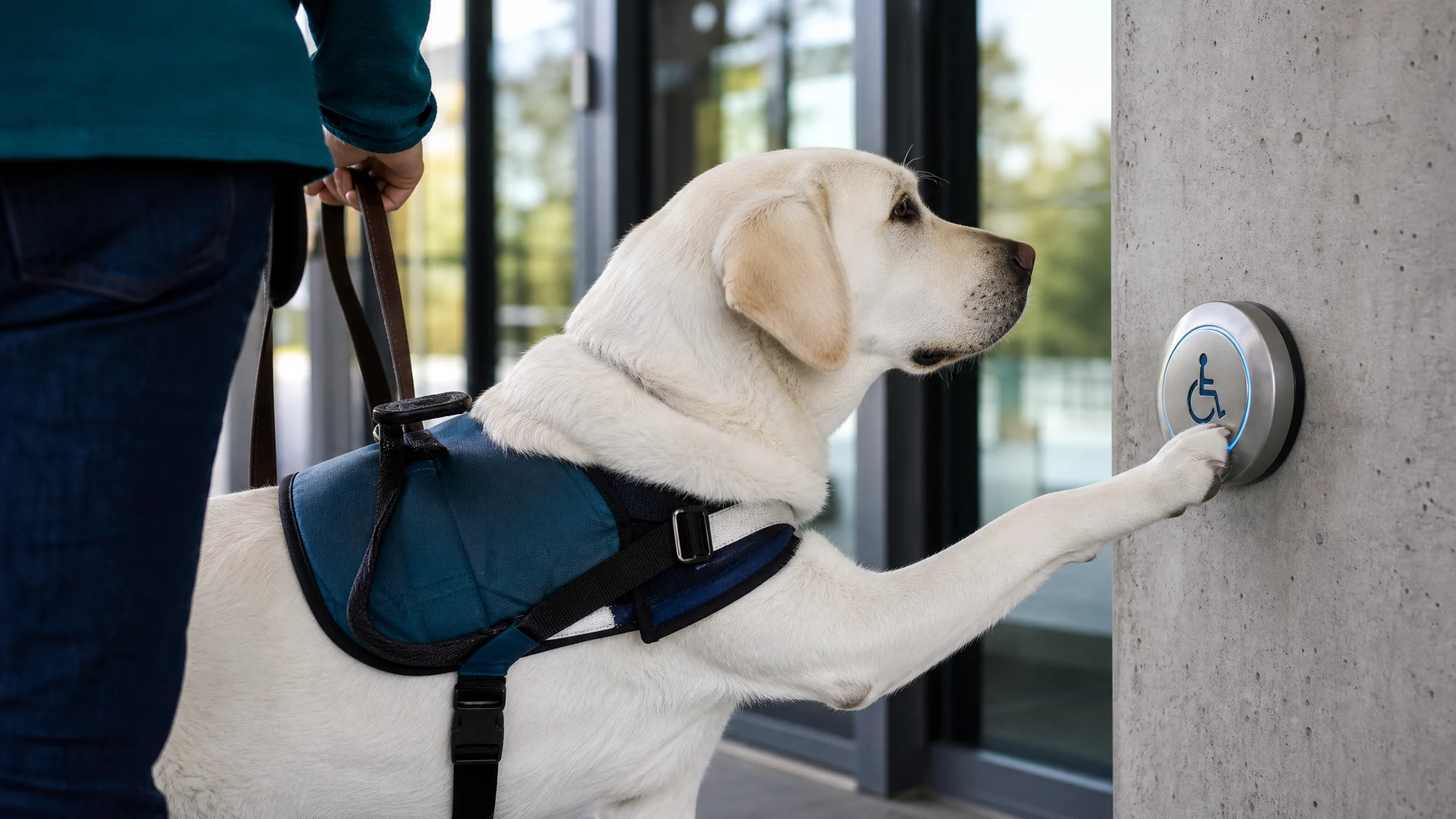
- Pulling a light switch cord or pressing an accessible door button.
Seizure and medical conditions
- Staying with a handler during a seizure and going for help on cue.
- Alerting to a change tied to a medical condition, such as blood sugar, when the dog has been trained to do so.
- Fetching a medication pouch or a phone.
Hearing disabilities
- Alerting to a smoke alarm, doorbell, alarm clock or a person calling the handler's name.
- Leading the handler to the sound source.
Psychiatric disabilities and PTSD
- Interrupting repetitive or self-harming behaviors with a nudge or paw touch.
- Turning on lights or checking a room on cue.
- Creating space in a crowd by standing behind or beside the handler.
- Waking the handler from a nightmare.
- Applying deep pressure on cue.
Autism
- Interrupting repetitive behaviors on cue.
- Anchoring a child or adult in place, or helping the handler stay with a caregiver in public, depending on the training plan.
- Providing trained pressure or grounding work.
Pennsylvania assistance dog organizations describe work in these same broad areas. For example, Susquehanna Service Dogs lists autism, mobility, PTSD, psychiatric, seizure and hearing partnerships. Canine Partners For Life lists diabetes, mobility, seizure and other medical needs. Which tasks are possible for you depends on your disability, your dog and your training plan.
The public access test is a benchmark, not a legal requirement
Assistance Dogs International (ADI) publishes a public access test that member programs use to check that a dog behaves well in public. Many owner-trainers borrow it as a practice standard.
It is important to be exact about what it is and what it is not:
- It is a training benchmark from ADI. It is not part of the ADA.
- The ADA does not require a service dog to pass any test, and ADA.gov describes no official registry or required certification.
- The PHRC states that no certification or license is required for service animals in Pennsylvania.
So why use it? Because the ADA does expect the dog to behave. Under ADA.gov guidance and PHRC guidance, service animals must remain under the handler's control. A well-run practice test shows you where your dog's public manners are strong and where they need more work. For the current test items and scoring, check ADI directly, since a program's version may change.
Treat any online certificate or ID card as what it is: not legal proof of anything. The law looks at the dog's training and behavior, not paperwork.
How to train tasks and practice for a public access test
Materials you will need
- A flat collar or a well-fitted harness, and a standard leash.
- Small, soft treats your dog loves, plus a treat pouch.
- A clicker or a marker word such as "yes."
- A training log, paper or digital, to note tasks, dates and progress.
- A settle mat or small blanket.
- Props for your specific tasks, such as a tug strap, a dumbbell for retrieves, or a light switch target.
- A friend or family member to help with distraction practice.
Rewards, not corrections, are the method here. This follows the position of the American Veterinary Society of Animal Behavior (AVSAB), which favors reward-based training. Do not use shock, prong or choke collars, or dominance methods.
Step 1: Write down the disability-related need
Start with the problem, not the trick. Write what is hard for you because of your disability, and what action from a dog would reduce that difficulty. Be specific. "Picks up my dropped phone and puts it in my hand" is a task. "Helps me feel better" is not.
Step 2: Choose two or three starting tasks
Do not try to train everything at once. Pick the tasks that matter most and build from there. A short list you can train reliably is better than a long list of half-learned behaviors. Your list can grow over time.
Step 3: Build the foundation first
Before tasks, your dog needs solid basics: sit, down, stay, come, loose-leash walking, a settle on a mat, and focus on you around distractions. Practice them at home, then in the yard, then in quiet outdoor spaces. These behaviors are the base for both tasks and public manners.
Step 4: Teach each task in small pieces
Break the task into steps and reward each one. For a retrieve, for example, you might reward looking at the item, then touching it, then picking it up, then holding it, then bringing it to you, then placing it in your hand. Mark the right moment with a click or "yes," then deliver the treat. Keep sessions short and end on a success.
Step 5: Add a cue and make the trigger clear
Once the dog does the behavior reliably, add a cue word or hand signal. For tasks done in response to something, such as an alarm sound or a change in your body, pair the trigger with the behavior until the dog starts offering it. Then practice in different rooms and positions.
Step 6: Proof the task in new places
Dogs often do a task perfectly in the living room and then forget it in a store. Move gradually: another room, the porch, a quiet parking lot, a pet-friendly store, and so on. Lower your criteria when the environment gets harder, and reward generously.
Step 7: Work on public manners
Public access skills are the behaviors a benchmark test looks at in general. Practice these:
- Walking calmly on a loose leash past people and other dogs.
- Ignoring food on the floor and dropped items that are not part of a task.
- Settling under a table or beside a chair for a long period.
- Staying quiet, without barking or whining.
- Staying focused on you when strangers approach or speak.
- Entering and exiting doorways, elevators and vehicles politely.
- Staying clean and well groomed, and relieving on cue in an appropriate place.
Step 8: Run a practice public access test
When your dog is steady, find the current ADI public access test and use its items as a checklist. Have a helper watch and note anything that slips. Do this in real places, in short visits, and keep a record of what you learned. If something fails, go back a step, train that piece, and try again another day.
Step 9: Keep training and keep records
Service dog training does not stop. Keep refreshing tasks and manners, and write down new tasks you add. Records help you describe your dog's training clearly if someone asks.
What staff can ask, and what Pennsylvania law says
When it is not obvious the dog is a service animal, ADA.gov says staff may ask only two questions: whether the dog is a service animal required because of a disability, and what work or task the dog has been trained to perform. This is why knowing your tasks matters. You should be able to answer the second question clearly and briefly.
In Pennsylvania, 18 Pa.C.S. 7325 makes it a summary offense for a proprietor, manager or employee of a place of public accommodation to refuse or deny access to a person using a service, guide or support dog or other aid animal to assist a person with a disability. The statute also covers a person training such an animal. Because the statute's terms and the PHRC's guidance can change, verify exact wording at palegis.us. The PHRC's proposed assistance animal guidance was open for public comment from October 1 to November 15, 2026, so check the PHRC for updates.
For a fuller look at training and access in the state, see our guide to service dogs in Pennsylvania, training and access rights.
Tips and common mistakes
- Calling comfort a task. Presence and calm alone are not trained tasks. Define an action the dog performs.
- Treating the public access test as a legal pass. It is a benchmark. Passing it does not create legal status, and failing it does not remove any rights.
- Buying a registration or ID. There is no official registry or required certification. The PHRC says none is required in Pennsylvania.
- Rushing into public. Moving too fast leads to stress and mistakes. Build in small steps.
- Using punishment. Harsh corrections can damage trust and make public work harder. Stay with reward-based methods.
- Skipping the training log. Notes make it easier to see progress and spot patterns.
- Misrepresenting a pet. Pennsylvania's housing laws penalize misrepresenting an animal as a service animal. Under 68 P.S. 405.6, using a false document, or a harness, collar, vest or sign, to do so is a summary offense with a fine not exceeding $1,000. Misrepresenting a disability or need in housing can be a third-degree misdemeanor under 68 P.S. 405.5.
What results to expect
Results vary with the dog, the handler, the tasks and the time spent. Many handlers find that steady, reward-based practice may help a dog learn reliable tasks over many months, and that regular public outings may improve the dog's manners over time. Some dogs may find public work too stressful or may not suit certain tasks. That is not a failure of the handler. Talk with a qualified trainer or an assistance dog program if you are unsure whether your dog is a good fit.
Programs in Pennsylvania, such as Susquehanna Service Dogs in Grantville, Canine Partners For Life in Cochranville and UDS Service Dogs in Lancaster, partner dogs with people who have disabilities. Check each program directly for its current waitlist, fees and eligibility, since those details change.
If you are denied access
The Pennsylvania Human Relations Commission accepts complaints about public accommodation, housing, employment and education. Complaints are generally due within 180 days of the alleged discrimination. This article is not legal advice, so contact the PHRC to learn how to file.
Sources
- ADA.gov, Service Animals FAQ
- Pennsylvania Human Relations Commission, Assistance, Emotional Support, and Service Animal Guidance
- Pennsylvania Human Relations Commission, Filing a Complaint
- Animal Legal and Historical Center, Pennsylvania Consolidated Assistance Animal/Guide Dog Laws
- Susquehanna Service Dogs, Keystone Human Services
- Canine Partners For Life, FAQs
- UDS Service Dogs Program